
Semper Fi, Semper Maria
Reflections from a 37-year Marine now serving Our Lady.
Officers Eat Last
Officers Eat Last
Vincent A. Coglianese · Major General, U.S. Marine Corps (Retired)
A Marine habit, learned in a chow line at Fort Benning, and the same shape in what the Blessed Mother asks of us.
In 2014 Simon Sinek published Leaders Eat Last: Why Some Teams Pull Together and Others Don’t. The title did not come from a marketing meeting. It came from a Marine. Sinek had been trying to understand why Marines pull together the way they do, and he put the question to Lieutenant General George Flynn, who later wrote the foreword. Flynn did not offer a theory. He said, “Officers eat last.” That was enough.
In the business world, people are told to pay themselves first. In the Corps, the opposite is the point. The junior Marine goes to the head of the chow line. The senior Marine waits. Nobody has to be ordered to do it. The willingness to give up food, time, comfort, or safety so the people in your charge are looked after is what the title means. Sinek built the book around that idea: a leader’s first job is to make a circle of safety for the people entrusted to him, even when it costs him something.
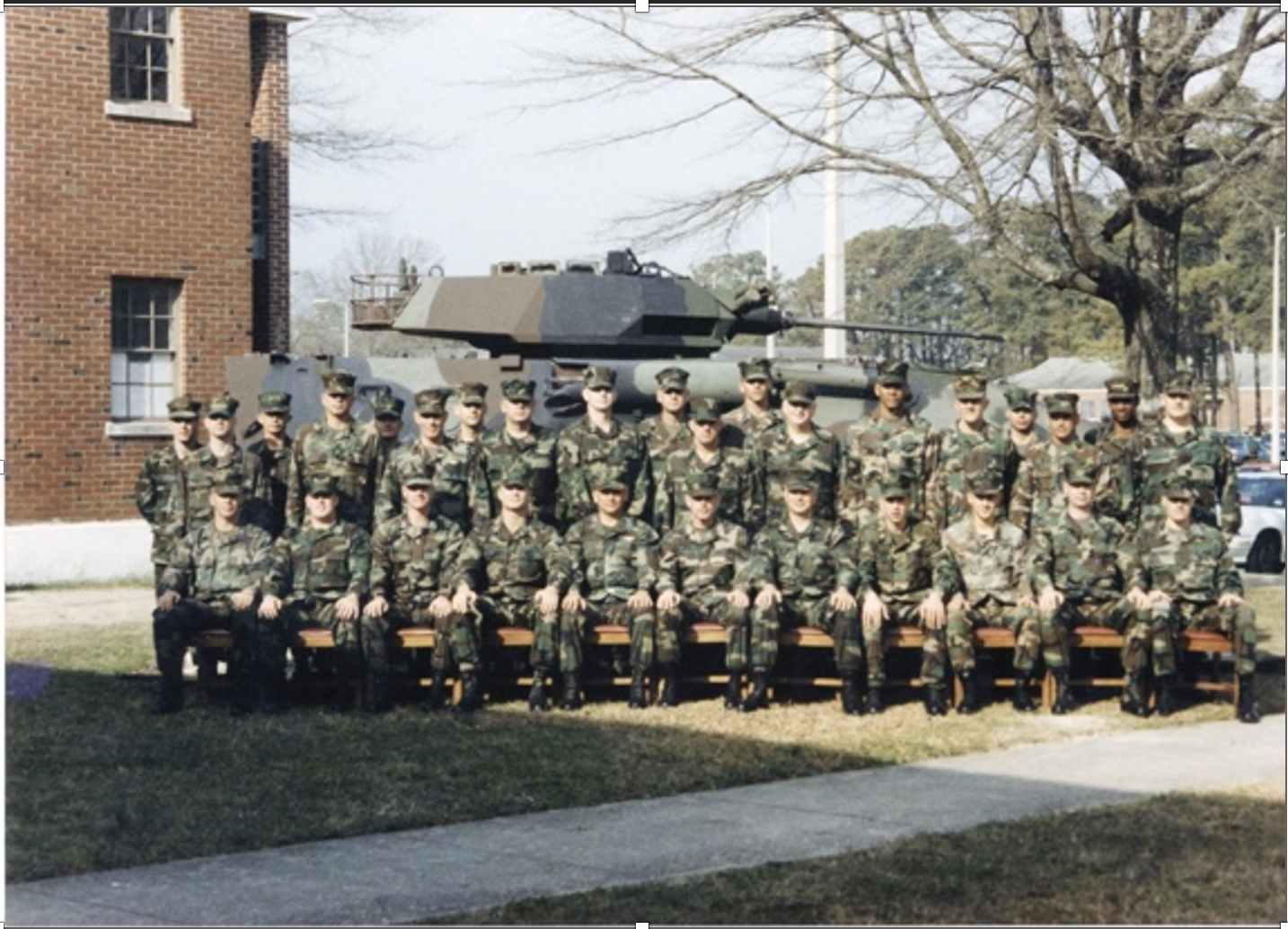
THE BATTALION
2d Light Armored Infantry Battalion command photo, 1993. The captains in that outfit had already proved themselves in combat.
The Marine Corps has long been called a university of leadership, and the tuition is paid in habits, not slogans. Servant leadership is not a course; it is the expectation. An officer leads from the front and does not ask a Marine to do what he will not do himself; he is expected to be in shape, often in better shape than the Marines he leads. From lieutenant to general, the good ones are usually the first ones in, before their Marines arrive.
Being senior in rank does not make you a better person than the Marines you lead. It does not mean you are smarter than they are. When I served as Inspector General of the Marine Corps, I would talk to the drill instructors at the Marine Corps Recruit Depots in San Diego and Parris Island. I told them that some of their recruits would become officers, senators, or maybe a vice president someday. Respect them. Train them hard. Inspections are routine, and the officer conducting them is under inspection too. The old line holds: it is ninety-nine percent what you do and one percent what you say.
I saw the habit of the chow line tested not long after Desert Storm. I had been the Headquarters and Service Company commander in 2d Surveillance, Reconnaissance, and Intelligence Group and had deployed with that unit. When I came home I transferred to the 2d Marine Division and became the S-4, the logistics officer, for 2d Light Armored Infantry Battalion. It was an elite outfit. All meat-eaters. Looking back, the captains — the company commanders and the staff — were top-notch Marines, and several of them had already proved themselves in combat. I remember telling my wife, Mary, that I was lucky to be with them, and that a lot of those men were better than I was. We had a fine battalion commander in Lieutenant Colonel McMenamin.
The Light Armored Vehicles carried a 25mm gun, and to qualify the crews we had to go to Fort Benning. Camp Lejeune did not have the ranges for it then. It was about a six-hundred-mile move, with an overnight stop at Fort Gordon, Georgia. As the logistics officer, I owned the convoy support and everything else the battalion needed once we got there. The schedule was jammed. Each company focused on gunnery for the vehicle crews and scheduled individual training for the infantry scouts who rode in the back. We stood up a field mess serving one hot meal a day, but a lot of Marines lived on MREs (meal, ready-to-eat) because they were scattered across the ranges.
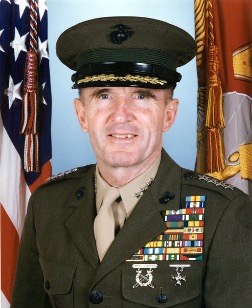
GENERAL NEAL Division commander on that visit. Later Assistant Commandant of the Marine Corps. |
We had the privilege of a visit from our division commanding general, Brigadier General Richard I. Neal. America knew him as the spokesman for Central Command during Desert Storm, the officer on CNN giving the daily updates. My mother became a fan of his, partly, I think, because she was Irish and so was he. He was a gentleman. We often saw him at Mass on Sundays at the Camp Lejeune chapel, setting the example for younger officers. It was all about presence. He later rose to four stars and served as Assistant Commandant of the Marine Corps.
His visit was a big deal, especially for the battalion commander. He told me that for the general’s visit we needed a special meal in the field mess. In the military, a command is allotted a few dollars for each Marine for field rations, and a commander has some discretion in how that money is used. We skimped on meals leading up to the visit so we could put steak and potatoes on the menu when the general came. |
I do not remember every hour of the visit. I do remember that he was personal and engaging. Word got around the battalion that there would be steak, so Marines who usually skipped the field mess showed up. We lined them up the Marine way. Junior men first. Officers last. For a while it went smoothly. Then, as the officers started through, I saw how little steak and potato was left. Some Marines had taken more than one. You could hardly blame them. The last man in the line was the general. A quick count told me we were not going to have enough.
I passed the word to the captains. Grab a steak and a potato and send it back. We handed it down the line, officer to officer, until it reached the general. He got his meal. He noticed what was happening, and I think he found some humor in it. I am less sure my battalion commander did. The moral did not need a speech.
“Officers eat last.”
THE MORAL DID NOT NEED A SPEECH
When General Neal finished his visit, I had the privilege of driving him to the airfield so he could catch his plane back to Camp Lejeune. He asked if there was anything he could do for me. I thought of my mother. I asked if he would sign a picture for her birthday. She was a real fan. He was gracious and did it. After she passed, I came across that picture and thought again what a good example he had been. I am proud that he was Catholic.
Years later I read Archbishop Fulton Sheen’s autobiography, Treasure in Clay. He wrote, “The Christian law is that the higher we go, the lower we are to become.” Our Blessed Lord had said, “Let the greatest among you be as the least.” Sheen admitted the danger that comes with the office: the pectoral cross, the ring, the zucchetto, the title Bishop. He called it a false euphoria, the pomp of the treasure making a man forget the clay. He confessed he had felt it. I have seen the same thing in uniform. The chow line is one habit that pushes back against it.
Recently, after our pilgrimage to Medjugorje, I learned about the five stones Our Lady asks of us. One of them is fasting. I can remember plenty of days on deployment and in the field when there was little to eat, or an MRE nobody wanted. In Iraq, on long convoys in extreme heat, a meal at a chow hall — field or hardstand — was something you were grateful for. In Afghanistan there was no chow hall for months. You ate what you had, when you had it, and you were glad of it. In a way we fasted. I wish I had thought of it that way at the time and offered it up.
IN THE FIELD A hot meal was not a sure thing. |
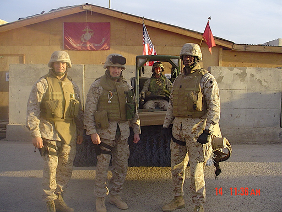
IRAQ, 2004 A chow hall was something you were grateful for. |
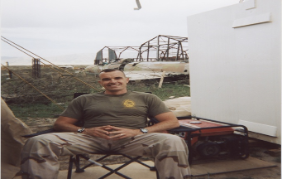 AFGHANISTAN AFGHANISTAN
First months. There was no hot chow. |
The Corps expects its officers to sacrifice: to eat last, to lead from the front, to work harder than the Marines they lead. I find the same shape in what the Blessed Mother asks of us. Fasting is giving something up for a greater good. As a general officer I used to hear people say they were impressed by the long hours and the constant moving. I would tell them it was all perspective. The young Marines in the field, training hard or deployed, going days with little sleep and little food — they were the ones sacrificing. When Our Lady asks us to fast, the sacrifice is not new.