
Semper Fi, Semper Maria
Reflections from a 37-year Marine now serving Our Lady.
The Priest Who Would Not Stay in the Vehicle
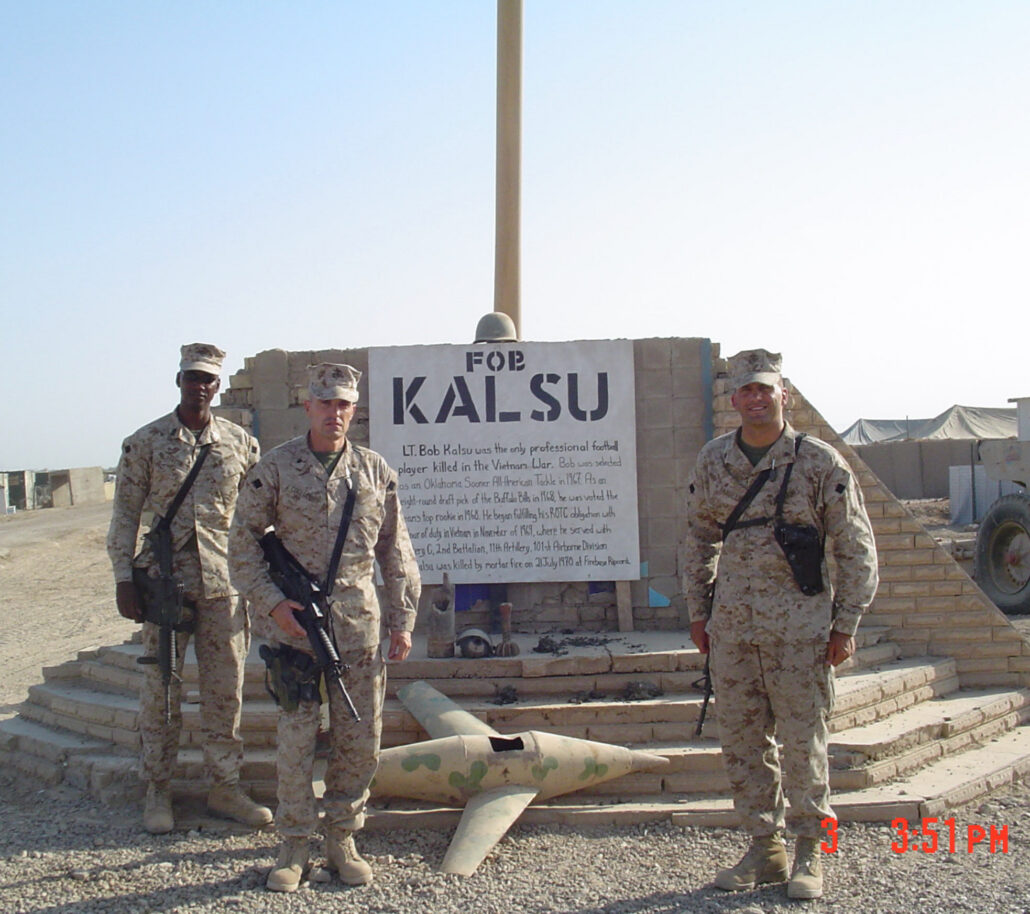
The Marine Corps has no chaplains of its own, and it has no medical corps of its own. Both come from the Navy. Navy chaplains and Navy doctors, nurses, and hospital corpsmen are assigned to Marine units and serve alongside Marines in garrison, in the field, and in combat. They wear the same dirt. They take the same risks. They are not visitors. They are part of the force.
That arrangement is easy to forget until you need one of them. Serving on a ship is one kind of ministry and one kind of medicine. Serving with Marines in heat, dust, isolation, and combat is another. I learned how much that presence matters in Afghanistan, and I learned it again in Iraq.
In January 2002, a Marine CH-53E Super Stallion went down south of Bagram on a resupply mission. The cause was mechanical failure. Two Marines were killed and five were injured. When the bodies were flown back to Bagram, I was the only Marine there. I went out to help offload them from the Army helicopter that had recovered them.
There was no chaplain around.
I checked the dog tags. The deceased were Catholics. I was not sure what to do. I blessed them and tried to administer last rites. I did not what I was doing. I only knew they were ours, they were Catholic, and they deserved better than an officer guessing at the prayers of the Church. I wished a chaplain had been standing there.
There is a shortage of Catholic priests in many dioceses. There is also a shortage of Catholic priests willing to serve as chaplains. During deployments, in peace or war, they are called to minister to Catholics and to Marines and Sailors of other denominations as well. Sunday Mass is not a given when deployed. Logistics, distance, and danger make it hard to get a priest to every outpost on Sunday. Sometimes there is no priest at all when you need one most.
During the Surge in Iraq I was with the 24th Marine Expeditionary Unit operating in northern Babil. I commanded Marine Service Support Group 24—what we called Super G. Our mission was to provide combat service support to every force attached to the 24th MEU. Travel on the roads was dangerous. The enemy’s weapon of choice was the improvised explosive device. They waited for a convoy, then detonated it to kill, wound, and destroy vehicles.
We were fortunate to have a Catholic chaplain who was willing to travel to the forward operating bases where our Marines and Sailors were living. Because of the distances and the risk, he could not say Sunday Mass at every post. So he moved throughout the week. He said Mass wherever he could get. He distributed Holy Communion. He heard confessions. He also handed out rosaries to anyone who wanted one.
I told him not to worry about getting around. We would put him in our convoys or give him a separate detail if he needed to go somewhere we were not going. He accepted. He was there to serve.
I have served with many chaplains over the years. Some were careerists more concerned with parking spots and promotion than with the Marines and Sailors who needed them. This priest was not one of them. He was determined to get Mass, Communion, and confession to as many as he could. My Marines knew it mattered to me that we took care of him and got him where he needed to go.
On one convoy coming back from the Baghdad area to northern Babil—about thirty miles south of Baghdad—the convoy was attacked. It was typical: indirect fire, mortars, small-arms fire. The Marines did what they were trained to do. They got out of the kill zone and engaged the enemy. They also called in close air support. When the aircraft came on station, it changed the fight. For the Marines in those vehicles, that was the best feeling of the day.
Chaplain Brown was in that convoy, riding in the vehicle with a young Catholic lieutenant, Erin Kelly. His Religious Program Specialist was initially on the radio. Then the RP was out of the vehicle with the security element, weapon in hand, while the chaplain stayed on the radio. As the Marines fought, the priest asked what he could do for them. Lieutenant Kelly told him that if he could reach out to the Big Man, that would probably be in their best interest.
The chaplain decided he was going to get out of the vehicle and check on everyone. He opened the hatch. Second Lieutenant Kelly would not let him.
“Father, what are you doing? Get back in that vehicle. If you get killed out here, my boss Lieutenant Colonel Coglianese will kill me.”
When they returned to base she told me the story. I could only smile. I told her she was right.
Years later Erin Kelly, who’s been married over 20 years still remembered the moment the same way. She remembered that she never felt scared—perhaps it was naiveté, she said, but the chaplain was with them. His gentle demeanor, and those eyes, brought a sense of calm to a vehicle under fire. She dug into her faith in those minutes. That faith, she wrote, has stayed with her even in seasons when she has not returned the effort. For her, he remains one of the strongest symbols of steadfast faith she carries.
The point was the priest. He was not thinking about his own safety first. He was thinking about the Marines who, at any moment, could be killed. We had many casualties on that deployment. Wounded men. Dead men. Going to Mass mattered. Receiving Our Lord mattered. Confession mattered. A rosary in a cargo pocket mattered. So did a priest who stayed on the radio in a hatch and asked what he could do, and then did the one thing no aircraft could do: he prayed.
A few years earlier, on a flight line in Bagram, Afghanistan, I had stood over Catholic Marines with no priest and only the poor prayers I could manage. In Iraq we had a priest who would ride into the kill zone so that living Marines would not have to face death without the sacraments.
There are many unsung heroes in combat—the medical teams, the convoy commanders, the young Marines who do their job under fire. Chaplains belong in that company. When Chaplain Brown reached a forward operating base, broke out his kit, and said Mass, it was appreciated by everyone. It meant more than most people will ever know.
Thank you, Chaplain, for risking your life for the sake of Christ.
Vincent A. Coglianese
Major General, U.S. Marine Corps (Ret.)